
When homeowners think about insulation, they usually focus on one thing: R-value. While R-value is important because it measures resistance to heat transfer, it only tells part of the story. In South Georgia and North Florida, where long, hot summers are paired with consistently high humidity, moisture can have just as much impact on your home’s comfort, efficiency, and durability as the heat itself.
Humid outdoor air that leaks into your home doesn’t just make your living spaces feel sticky. It can find its way into wall cavities, attics, and crawl spaces, where it may condense on cooler surfaces, dampen insulation, and create conditions that encourage mold growth and wood rot. Even the highest R-value insulation can’t prevent these issues if humid air is allowed to move freely through your home’s building envelope.
South Georgia (including the Valdosta and Adel area) and North Florida (including Tallahassee) sit in IECC Climate Zone 2A, classified as hot-humid. In this climate, humidity matters as much as heat because moving air, not the slow drift of vapor through solid materials, carries most water vapor into a building. Virginia Cooperative Extension reports that air infiltration can carry 50 to 100 times more moisture into wall cavities than vapor diffusion, which means sealing air leaks is one of the most effective ways to control moisture.
 This means that the strongest approach pairs insulation with air sealing and favors materials suited to moisture conditions, while keeping indoor relative humidity in a healthy band. University of Florida IFAS Extension recommends staying below 70%, ideally between 45% and 60%, to discourage mold growth.
Not sure whether your insulation is fighting humidity or quietly trapping it? A free home insulation evaluation can show you where humid air is getting in.
Humidity and Insulation: Why Climate Zone 2A Changes Everything
The U.S. Department of Energy classifies this region as IECC Climate Zone 2A, characterized by long cooling seasons, high annual rainfall, and extended periods of elevated humidity. The Department of Energy’s Building America program defines our climate as hot-humid, one that receives more than 20 inches of annual precipitation and reaches high warm-season wet-bulb temperatures (a 67°F or higher wet-bulb temperature for 3,000+ hours, or 73°F or higher for 1,500+ hours, during the warmest six months). In practical terms, that means your home spends much of the year battling both heat and moisture, making insulation decisions more complex than simply choosing the highest R-value.
 That’s because R-value measures resistance to heat flow, not moisture control. While insulation slows the movement of heat, it doesn’t stop humid air from leaking into your home through gaps and cracks in the building envelope. The University of Missouri Extension emphasizes that insulation, air sealing, and moisture management all work together to improve a home’s energy efficiency, comfort, and durability, and that the right insulation strategy depends on your local climate.
In a hot-humid region like ours, controlling air movement is just as important as adding insulation. The University of Florida IFAS Extension notes that drafty homes allow warm, humid outdoor air to continually enter through small openings, bringing unwanted moisture indoors. A tighter, properly air-sealed home helps reduce the moisture load, allowing your insulation to perform as intended while improving comfort year-round.
How Humidity Actually Gets Into Your Home
Many homeowners assume moisture slowly seeps through walls or insulation. In reality, air movement is by far the biggest way humidity enters a home.
Virginia Cooperative Extension reports that air infiltration can bring 50 to 100 times more moisture into wall cavities than vapor diffusion. As warm, humid outdoor air moves from areas of higher pressure to lower pressure, it slips through tiny gaps around windows, doors, plumbing penetrations, electrical wiring, attic hatches, and other openings in your home’s building envelope. Once inside, that moisture travels wherever the air goes.
The University of Florida IFAS Extension notes that this uncontrolled outdoor air is responsible for much of the moisture load your air conditioning system must remove. The more humid air that leaks inside, the harder your HVAC system has to work to keep your home comfortable.
When Humid Air Meets Cooler Surfaces
Problems begin when that warm, moisture-laden air reaches cooler surfaces inside your walls, attic, or crawl space. As the air cools to its dew point, the water vapor condenses into liquid moisture.
Over time, that trapped moisture can reduce the effectiveness of your insulation while creating conditions that encourage mold growth, wood rot, and other hidden structural damage. The University of Missouri Extension notes that when condensation occurs inside an insulated wall, the insulation becomes wet, which can lead to the decay of building materials, so trapped moisture quietly undermines both the insulation’s performance and the structure around it. Even high-performance insulation can’t deliver its rated R-value if it becomes damp.
Why Air Sealing Comes First
This is why air sealing should be the first step in any insulation strategy for a hot-humid climate. By sealing the small cracks and gaps where outside air enters, you stop much of the moisture before it ever reaches your insulation. ENERGY STAR reports that air leakage can account for 25% to 40% of the energy used for heating and cooling in a typical home, making air sealing one of the most effective ways to improve both energy efficiency and moisture control.
It’s also important to understand that air barriers and vapor barriers are not the same thing. In South Georgia and North Florida, stopping the movement of humid air is typically the higher priority because air carries the vast majority of moisture into a home. That’s why pairing quality insulation with professional air sealing creates a much more effective defense against humidity than insulation alone.
Choosing the Right Insulation for a Humid Climate
When selecting insulation for South Georgia or North Florida, the goal isn’t simply choosing the highest R-value. It’s selecting materials that perform well under humid conditions while pairing them with proper air sealing.
Spray Foam Insulation
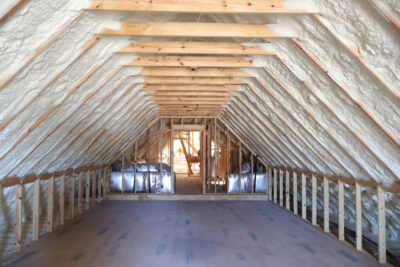 Spray foam insulation both insulates and air seals in a single application, making it one of the most effective options for hot-humid climates.
When it comes to open cell vs closed cell spray foam, there are a few key differences. Open-cell spray foam remains vapor permeable, allowing assemblies to dry while still providing excellent air sealing. Closed-cell spray foam is denser, offers a higher R-value per inch, and provides greater vapor resistance, making it an excellent choice for crawl spaces, rim joists, and other moisture-prone areas.
Mineral Wool
Mineral wool performs exceptionally well in humid environments because it resists moisture, maintains its shape, and does not readily support mold growth. Like other batt insulation products, however, it still requires proper air sealing to achieve its full performance potential.
Fiberglass and Cellulose
Fiberglass and cellulose continue to be excellent, cost-effective insulation materials. However, neither material creates an air barrier on its own. Their effectiveness depends on remaining dry and being installed alongside a dedicated air-sealing strategy that prevents humid air from reaching the insulation.
It’s also important to remember that vapor retarder placement varies by climate. In hot-humid regions like South Georgia and North Florida, improper vapor retarder placement can trap moisture where it doesn’t belong. The Department of Energy’s Building America program advises against installing Class I vapor retarders on the interior side of walls in warm-humid climates, the opposite of the cold-climate convention. That’s why insulation systems should always be designed with the local climate in mind rather than following cold-climate recommendations.
Where Humidity Hits Hardest
Some areas of the home are especially vulnerable to moisture intrusion.
Crawl Spaces
Crawl spaces often experience the highest moisture levels in hot-humid climates. Sealed, properly insulated crawl spaces with moisture control measures and ground vapor barriers generally perform much better than traditionally vented crawl spaces. The Department of Energy’s Building America program notes that in hot, humid climates, building (or converting to) an unvented, sealed crawl space with proper moisture control and drainage is often the best option — insulating and air-sealing the foundation walls, with a ground vapor barrier, rather than the floor above.
Attics
Attics combine extreme summer temperatures with high humidity. Air sealing attic floor penetrations before installing insulation helps keep humid outdoor air from entering the home. Homes with HVAC equipment located in the attic may also benefit from conditioned, unvented attic assemblies that keep ducts out of harsh attic conditions.
Walls
Exterior walls should be carefully air sealed around top plates, windows, electrical boxes, plumbing penetrations, and other openings before insulation is installed. Preventing humid air from entering wall cavities is far more effective than trying to manage moisture after it gets inside.
When insulation and air sealing work together as a complete system, homeowners often enjoy lower utility bills, more consistent indoor temperatures, improved comfort, and better humidity control throughout the year. ENERGY STAR estimates that homeowners can save an average of 15% on heating and cooling costs by air sealing their homes and adding insulation in attics, floors over crawl spaces, and basements — and in this climate, that same work is what brings indoor humidity under control
Frequently Asked Questions
Don’t Let Humidity Undermine Your Insulation
R-value answers the heat question, but it says nothing about humidity. For South Georgia and North Florida insulation, the moisture you can’t see is often what causes the greatest long-term damage to building materials and indoor comfort.
The best approach combines the right insulation material with effective air sealing to control both heat and moisture throughout the home.
Quality Insulation of Valdosta installs and air-seals insulation across South Georgia and North Florida, and can evaluate where humid air is getting into your home and which approach fits each space. Call 229-444-1823 in Georgia or 850-519-3003 in Florida to schedule a free estimate.
ENERGY STAR. “Air Sealing: Building Envelope Improvements.” U.S. Environmental Protection Agency, www.energystar.gov/ia/home_improvement/home_sealing/AirSealingFS_2005.pdf.
ENERGY STAR. “Why Seal and Insulate?” U.S. Environmental Protection Agency, www.energystar.gov/saveathome/seal_insulate/why-seal-and-insulate.
U.S. Department of Energy. “Class I Vapor Retarders Not Installed in Above-Grade Walls in Warm-Humid Climate.” Building America Solution Center, Pacific Northwest National Laboratory, basc.pnnl.gov/resource-guides/class-i-vapor-retarders-not-installed-above-grade-walls-warm-humid-climate.
U.S. Department of Energy. “Climate Zones.” Building America, www.energy.gov/cmei/buildings/climate-zones.
U.S. Department of Energy. “Unvented, Insulated Crawlspaces.” Building America Solution Center, Pacific Northwest National Laboratory, basc.pnnl.gov/resource-guides/unvented-insulated-crawlspaces.
U.S. Department of Energy. “Vented to Unvented Crawl Space.” Building America Solution Center, Pacific Northwest National Laboratory, basc.pnnl.gov/home-improvement-expert/checklists/vented-unvented-crawl-space.
University of Florida IFAS Extension. “Energy Efficient Homes: Air Conditioning.” EDIS, edis.ifas.ufl.edu/publication/fy1026.
University of Florida IFAS Extension. “Energy Efficient Homes: Indoor Air Quality and Energy.” EDIS, edis.ifas.ufl.edu/fy1044.
University of Missouri Extension. “Insulating and Weatherizing Your Home.” University of Missouri, extension.missouri.edu/publications/gh4881.
Virginia Cooperative Extension. “ENERGY SERIES: What About Moisture?” Virginia Tech, pubs.ext.vt.edu/2908/2908-9020/2908-9020.html.